


KBR to set global benchmarks for liquid hydrogen engineering on EcoLog’s Amsterdam terminal.
KBR has been selected to deliver the Front-End Engineering Design (FEED) for the groundbreaking EcoLog Terminal in Amsterdam, the world’s first commercial‑scale facility designed to import liquid hydrogen (LH₂) and export liquid CO₂ (LCO₂). The terminal, now under development in the Port of Amsterdam, represents a major step forward in building global-scale hydrogen and carbon management infrastructure.
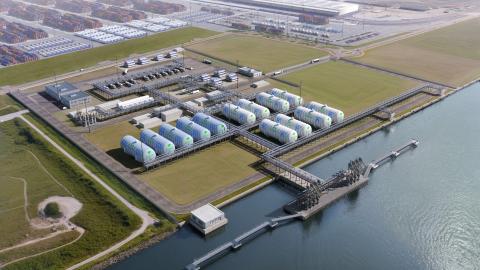
A Strategic Energy Hub for Europe’s Net‑Zero Future
Located in one of Europe’s most important energy and logistics gateways, the EcoLog Terminal is poised to become core infrastructure supporting the decarbonization of key industrial sectors - steel production, heavy-duty mobility, maritime transport and data centers - across Northern Europe.
Once operational (targeted for end of 2030), the terminal will receive, store and distribute both gaseous and liquid hydrogen while also managing LCO₂ for reuse or permanent storage abroad. Initial annual throughput is planned at 200,000 tonnes of LH₂ and 1.8 million tonnes of LCO₂, with potential expansion to 600,000 tonnes and 4.25 million tonnes respectively.
To enable large-scale LH₂ transportation, EcoLog is developing a new generation of purpose‑designed liquid hydrogen carriers that will directly serve the terminal.
KBR’s FEED Scope: Setting Global Benchmarks for LH₂ Engineering
Under this FEED award, KBR will define the terminal’s engineering basis, storage systems, operational envelope and safety standards, laying crucial foundations for the world’s first commercial LH₂ import system and its associated cryogenic infrastructure. The FEED is expected to be complete in 2026.
“KBR brings decades of deep technical expertise in complex energy infrastructure, including our work with NASA developing liquid hydrogen systems,” said Jay Ibrahim, President, KBR Sustainable Technology Solutions. “This project represents a historic first for the industry and positions both KBR and EcoLog at the forefront of technologies that will shape future low‑carbon supply chains.”
Creating a Complete End‑to‑End LH₂ and CO₂ Value Chain
The EcoLog Terminal Amsterdam is expected to unlock new international supply routes by connecting future hydrogen and CO₂ production hubs with industrial demand centers across Europe.
The design will incorporate multiple transport modalities, including:
- Dual hydrogen pipeline connections (high- and low‑pressure)
- A dedicated CO₂ pipeline
- A truck loading facility
- A barge jetty
- Rail access
KBR’s work will also include integrating the terminal with EcoLog’s next‑generation LH₂ vessels and downstream distribution systems. A key engineering focus will be capturing and re‑utilizing the cold energy released during LH₂ regasification to efficiently liquefy CO₂—an innovation that enhances both sustainability and system performance.
EcoLog’s Perspective: A Milestone for Europe’s Energy Transition
“Commissioning FEED is a proud moment for the entire EcoLog team,” said Ellen Ruhotas, CEO of EcoLog. “The EcoLog Terminal Amsterdam holds great promise for Europe’s decarbonization ambitions, and we look forward to bringing this to fruition together with KBR.”
Advancing Global Standards for Liquid Hydrogen Infrastructure
Beyond its commercial importance, the project offers a rare opportunity to define global engineering standards for LH₂ transport, handling and storage at scale—critical components in enabling a robust hydrogen economy.
With strong momentum in clean energy markets, this project marks another major step in KBR’s expansion across CO₂ management, hydrogen solutions, cryogenic systems and next‑generation low‑carbon infrastructure.