


Training for high-risk work environments… virtually
All jobs come with responsibility. But some come with real danger. Whether it’s working in confined spaces, handling hazardous chemicals, or operating in extreme conditions, some work environments require intensive training to ensure people stay safe on the job.
But how do you train people for high-risk work environments without putting them in harm’s way?
One answer is virtual training. Using immersive technologies like virtual reality (VR), workers can be placed in realistic, high-risk scenarios without ever being exposed to actual danger.
For virtual training to be effective in high-risk environments, it must be realistic. That’s where KBR’s Immersive Technology Solutions (ITS) team excels. From space station airlocks to hazardous water treatment plants, KBR’s ITS team re-creates complex, high-risk settings to help people prepare for work in high-risk environments, safely and effectively.
NASA International Space Station airlock
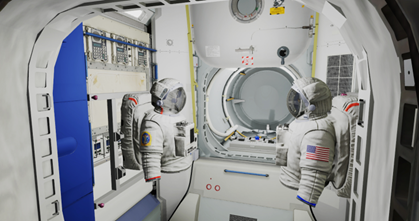
At NASA, astronauts train for life in space using a physical mock-up of the International Space Station (ISS) airlock. However, the high demand for the mock up causes bottlenecks and limits training opportunities. To help meet training demand, KBR developed a fully immersive VR version of the ISS airlock. Using VR goggles, astronauts can now train in a digital replica of the airlock – at anytime, from anywhere, with or without an instructor virtually present.
The simulation is so realistic that it allows astronauts to rehearse both routine and emergency procedures, including scenarios too dangerous to practise in real life. View a demo here.
Water treatment plant operator training
Municipal water and wastewater treatment facilities are high-risk environments. Dangers from toxic chemicals, confined spaces, operating machinery and plant are just a few of the many risks workers face each day.
To improve safety outcomes, KBR created an immersive VR training program for plant operators in Australia. Rather than learning from manuals or 2D videos, operators can virtually walk through a plant to identify hazards, rehearse procedures and practice emergency responses – all before ever setting foot in a treatment plant. Training can include rare scenarios that are difficult to practice, or too dangerous to simulate, in real life - such as chemical spills, chlorine gas leaks, electrical emergencies, working at heights, or confined space rescues.
Navy training - LHD marine systems technicians
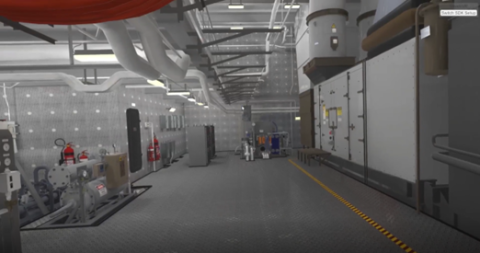
Marine Systems Technicians (MSTs) on Australia’s largest naval vessel, the Landing Helicopter Dock (LHD) are responsible for twice-daily monitoring of engine room systems. Dozens of gauges, dipsticks and displays are checked, verified and recorded during their 5Km journey through two engine rooms. Remembering how and where to monitor equipment is one challenge, safely navigating their way is another.
At the completion of classroom training, MSTs had a solid foundation of knowledge. With the addition of KBR’s virtual reality ‘MST Rounds’ training, their confidence and readiness increased significantly. Using VR to practice, trainees experience unlimited full-length rehearsals in a completely safe environment, all without the need for an experienced escort. The VR training increases safety and significantly reduces the need for qualified MST escorts, delivering ‘job ready’ personnel in record time.
KBR delivers industry-leading 3D visualisations and spatial applications that bring high-risk scenarios to life. Through immersive technology, people can experience hazardous environments virtually. By experiencing life-like situations in a controlled setting to build competence and safety awareness, it helps to improve safety outcomes in the real world.